
Shopware Community Day 2026: Shopware Becomes the Open Commerce Infrastructure for the Agentic Era
Schöppingen/Cologne, June 10, 2026 — AI is already changing commerce. Buyers are shifting, agents are entering the stack, and the gap between prepared and unprepared merchants is widening. At Shopware Community Day 2026 in Cologne, more than 1,700 merchants, partners, and developers gathered to hear Shopware’s answer: an open commerce infrastructure for the agentic era. Guided by the principle “grow your way, automate the work, and elevate the experience,” one message ran through the day: in an AI-driven market, creating context by combining data streams und business logic is the real differentiator. Shopware is the place where this context gets created and keeps merchants in control of how AI acts on it. This message was reinforced by four connected product launches: Shopware Nexus, Shopware Copilot, Shopware Payments, and Experience Studio as a research preview.
The Question Every Merchant Needs to Answer
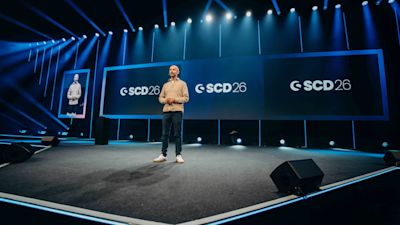
Shopware Co-CEO Sebastian Hamann opened the keynote with a provocation: in a world where machines are starting to buy, why would anyone still choose to buy from you? His answer described two parallel realities. For AI-driven discovery and autonomous purchasing, merchants need technical readiness: MCP coverage, agent-compatible APIs, and workflow automation. For human buyers, the priority is the opposite: emotion, trust, and brand experiences no algorithm can replicate.
“Shopware’s role is to help merchants act early in this transition, stay in control, and turn uncertainty into opportunity, together with the community that has always shaped the platform.” - Sebastian Hamann, Shopware Co-CEO.
The message: grow your way, automate the work, and elevate the experience.
Speed and Adaptability Become Decisive
Shopware CFOO Joachim Weber grounded the company’s vision in market reality. While ecommerce continues to grow across B2C and B2B, average growth rates hide a widening divide: the merchants gaining share are those who invested early in speed, flexibility, and infrastructure they control. Weber pointed to companies such as Beijer Ref, which consolidated operations across 35 instances and 28 countries in 36 months, and Toyota, which connected 400 dealers through a single hub. Together with brands like Asam Beauty, or UPPAbaby as the US-based premium baby gear brand, these examples show where Shopware’s strength becomes most visible: in complex commerce environments that require flexible B2B models, multi-organization structures, individual pricing, and high-volume catalogs.
That is why brands across B2C and B2B run on Shopware as their open commerce infrastructure. The platform adapts to complex requirements instead of forcing merchants into rigid boundaries. This positioning is reflected in Shopware's strong growth momentum, carried by marquee logo wins and hundreds of merchants signing with Shopware in the last 12 months. Just as important is the ecosystem behind the platform: a global community of developers, partners, and merchants who build, extend, and improve it every day. In an open-source model, that ecosystem becomes part of the advantage: more builders, more extensions, and more shared progress.
“The key isn’t how fast the market grows. It’s whether you’re positioned to capture what’s there and whether you can adapt when that positioning needs to change.” - Joachim Weber, Shopware CFOO.
The Foundation: An Agentic-Native Commerce Core
Before the new launches comes the ground they all run on. Shopware CPTO Mark Stanley introduced the company’s core platform investment as the place where transactions happen, pricing logic lives, customer relationships form, and where agents will increasingly operate.
Shopware now delivers 100% MCP coverage and UCP-readiness, making every action in the platform accessible to AI tools and agents, with response times 60% faster and deployment cycles 10x faster on Shopware PaaS. Combined with its API-first, open-source architecture, this lets merchants build complex B2B models, multi-organization structures and custom workflows without caps, workarounds or vendor lock-in.
“Shopware PaaS makes scaling simpler: easy setup, cost-effective autoscaling, 10x faster deployments, while keeping merchants in control of their cloud, data, and rules.” - Mark Stanley, Shopware CPTO.
On this foundation, Shopware introduced four connected launches.
Shopware Nexus: Bringing the Context Together
AI is only as good as the context it can see, and today that context is fragmented: a merchant’s business logic sits siloed across an average of more than 15 disconnected tools (ERP, CRM, PIM, and more), with up to 52% of implementation effort spent wiring them together rather than on differentiation. Shopware Nexus is the native, event driven orchestration layer that replaces fragmented middleware & brittle custom integrations with one central data synchronization hub. Reusable, standardized connectors, automated data mapping and AI-assisted workflow generation result in 40% lower integration costs and dramatically reduce time-to-market.

Shopware Copilot: Creating Outcome from Context
With the context unified, Copilot acts on it. Now agentic, Copilot moves beyond analysis to execution: It understands a merchant’s real business context and can perform analyses, provide recommendations, and execute actions within a workflow — in minutes rather than, as is often the case, over hours and across multiple features, while the merchant keeps full oversight of his data, rights and restrictions.
The safety mechanisms focus on human-in-the-loop: Role restrictions, entity whitelisting, and a draft & review process with a human to ensure: Autonomy where it helps, and control where it matters. Today, that means acting on demand, the future roadmap leads toward highly autonomous agents with Shopware as the platform where business logic, proprietary context, and control converge, enabling agents to surface risks or highlight opportunities based on the data context before the merchant would recognize. Copilot is hosted on European servers and built around consent and transparency with no black boxes and no data movement without the merchant’s approval. It works on its own, and it soon will learn from all its interactions as well as the context amplified by Shopware Nexus.
“Copilot moves beyond analysis to execution: it understands a merchant’s real business context.” - Sebastian Hamann, Shopware Co-CEO.

Shopware Payments: Closing the Loop, Natively
Shopware Payments adds a native payment layer built directly into the platform. Because it is Shopware-embedded, merchants can activate and manage payments in the same environment as their data, workflows, and business logic. Powered by PayPal’s global, regulated infrastructure, it brings international coverage, security, compliance, and fast onboarding. It remains optional by design and avoids lock-in, allowing merchants to retain full control over their payment strategy and add other providers at any time. Payments is available today in Germany and Austria, with the EU and the United States to follow.
Experience Studio: From Intent to Living Commerce Experiences
As AI agents take on more of the transactional work in commerce, merchants will need to compete on what automation cannot easily reproduce: emotion, trust, and brand identity. This is where Shopware Experience Studio comes in. Introduced as a research preview, it will enable merchants to create fully functional commerce frontends and story-led shopping experiences in minutes rather than weeks, simply by describing what they want. The goal is to help merchants build differentiated, human-led storefront experiences that connect content, context, and commerce in a more intuitive way. Shopware is developing the preview together with its community, giving users the opportunity to test the technology, experiment with prompts, and automatically generate high-quality, emotionally engaging experiences.
A Connected Architecture
The four launches were all part of one and the same architecture. While the Commerce Core is the foundation, Shopware Nexus unifies the context, and Copilot acts on it. Experience Studio turns it into brand and emotion, and Payments completes the journey. The thread holding them together is ownership: in an agentic market, a merchant’s data and context are the real moat, and Shopware is built to keep both in the merchant’s hands.
A Day of Inspiration
60 speakers shared insights across three main stages at SCD, with sessions on AI, B2B, automation, and intelligent growth. External contributors included Tilman Resch (OpenAI), Christina Schmitt (Forrester), Efe von Thenen (Besser werden) and Laura Kremer (Kandu).
Full keynote and product details: https://www.shopware.com/en/products/updates/
Contact

Wiljo Krechting
Manager Public Relations
Wiljo Krechting is an ecommerce expert and Manager Public Relations at the ecommerce platform provider Shopware. The media professional has a master’s degree in political science and journalism from the universities of Münster and Melbourne, where he gained experience as a foreign correspondent for the publisher Axel-Springer-Verlag. Krechting has worked as a journalist at Rheinische Post, WELT, BILD, Hamburger Abendblatt and the Australian business portal theaustralian.com.
Worldwide: 00 800 746 7626 0
Subscribe to the newsletter:
public.relations@shopware.com