
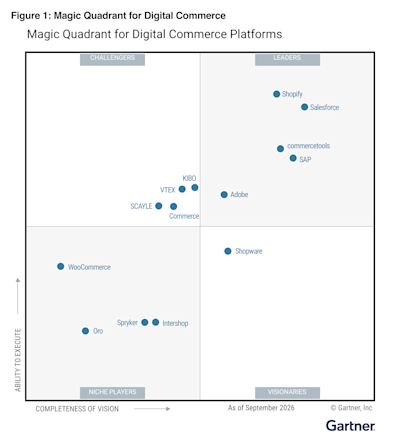
Shopware has been named the only Visionary in the 2026 Gartner® Magic Quadrant™ for Digital Commerce Platforms, marking the seventh consecutive year our platform has been included among the providers evaluated worldwide. It is the third time Shopware has been named a Visionary. The 2026 report evaluates 14 digital commerce platforms.
In this article, we explain what the Gartner Magic Quadrant is, what Shopware’s placement means to us and how our AI and Agentic Commerce capabilities support merchants today – as well as where we see commerce going next.
Whether you are evaluating a digital commerce platform or planning how your business will serve customers in the future, this article looks at the ideas and product capabilities shaping Shopware’s direction.
Learn why Gartner named Shopware a Visionary: Download the report.
What the Gartner® Magic Quadrant™ is – and why it matters
A Gartner Magic Quadrant is a culmination of research in a specific market, giving you a wide-angle view of the relative positions of the market’s competitors. A Magic Quadrant provides a graphical competitive positioning of four types of technology providers, in markets where growth is high and provider differentiation is distinct:
Leaders execute well against their current vision and are well positioned for tomorrow.
Visionaries understand where the market is going or have a vision for changing market rules, but do not yet execute well.
Niche Players focus successfully on a small segment, or are unfocused and do not out-innovate or outperform others.
Challengers execute well today or may dominate a large segment, but do not demonstrate an understanding of market direction.
We believe by applying a consistent set of evaluation criteria and a standardized graphical format, each Magic Quadrant helps business and IT leaders assess which providers best align with their goals and strategies. In our opinion, the Magic Quadrant for Digital Commerce Platforms also illustrates how technology vendors differ in innovation, execution and market focus.
For merchants, it can be one reference point when assessing platforms against business needs and future plans. It does not replace evaluating how a platform fits your own commerce model, customers and operations.
For more details about the methodology and how to interpret the quadrants, Gartner provides a full overview in its Magic Quadrants Research methodology.
How Gartner positioned Shopware in the 2026 Magic Quadrant™ for Digital Commerce Platforms
Shopware is the only vendor positioned as a Visionary in the 2026 Gartner® Magic Quadrant™ for Digital Commerce Platforms. The report evaluates 14 digital commerce platforms worldwide. Shopware has now been included among evaluated providers for seven consecutive years and has been named a Visionary for the third time.
What being a Visionary means for Shopware
For us, this placement connects with a direction we have been pursuing: giving merchants an open commerce platform and building for a future in which AI agents can take part in product discovery and commerce workflows. We believe that merchants need both useful capabilities today and a platform that can evolve as the way people buy continues to change.

“We never set out to simply manage commerce, but to keep rethinking it. We think Gartner positioning Shopware once again as a Visionary, and this time as the only one, confirms this path. And it spurs us on: with agentic AI and an open, scalable platform for B2B and B2C, we aim to shape the next era of commerce.”
– Sebastian Hamann, Co-CEO and Co-Founder of Shopware
We see AI and Agentic Commerce as part of a broader shift in how merchants manage commerce – from the tools teams use in the administration to the ways customers discover products and place orders. Here is how that direction connects to Shopware’s product.
A closer look at the topics shaping Shopware’s vision
Agentic Commerce – extending commerce to AI-powered journeys
Shopware’s Agentic Commerce sales channel is designed to support commerce experiences involving AI agents. The Shopware MCP Server provides an integration layer through which AI applications can interact with Shopware. Shopware also supports UCP.
For merchants, these building blocks point toward commerce experiences that can extend beyond a traditional storefront. They give businesses and partners ways to connect Shopware with AI-driven workflows while keeping control of their commerce setup.
Shopware Copilot – AI support in the administration
Shopware Copilot brings AI into the Shopware administration. It can support teams with everyday work such as generating SEO content, preparing promotion rules, updating product variants and working with data insights. Merchants stay involved in reviewing and confirming actions.
The goal is to help teams spend less time on repetitive administrative work and more time on the decisions and customer experiences that move their business forward.

Shopware Nexus – connecting workflows and systems
Shopware Nexus gives merchants a visual way to connect commerce workflows with systems such as ERP and CRM. Its event-driven approach helps teams coordinate processes across their commerce environment.
As AI becomes more involved in commerce operations, connected workflows and data give merchants a foundation for extending automation across the systems they already use.
Digital Sales Rooms – bringing people into complex commerce journeys
Shopware Digital Sales Rooms let buyers and sales representatives collaborate around products and quotes, including through video meetings and co-browsing. They extend the digital buying experience for merchants managing more involved B2B interactions.
As AI creates new ways to discover and transact, human guidance remains valuable in commerce journeys where buyers need product expertise, discussion or support.

Virtual product consulting with Shopware Digital Sales Rooms – personalized B2B sales experiences in real time.
An open platform for what comes next
Shopware’s open approach gives merchants and partners flexibility to connect systems, shape workflows and build commerce experiences around their business. It also creates room to develop further AI and agentic capabilities.
Looking ahead, Shopware’s vision includes AI quote agents, AI sales agents, B2B buyer agents and agent-to-agent negotiation. These planned areas extend the direction already taking shape in Shopware: bringing AI into commerce operations and preparing for buying journeys involving agents.
How we are building on our recognition as a Visionary
Being named a Visionary in the 2026 Gartner® Magic Quadrant™ for Digital Commerce Platforms reflects a direction Shopware continues to pursue: open commerce, innovation and Agentic Commerce. We will keep developing the platform and its ecosystem to help merchants respond to changing customer expectations and explore new commerce opportunities.
To explore the full analysis by Gartner and learn how Shopware is evaluated, download the report or speak with one of our experts.
Further reading
You might also be interested in:
Gartner, Magic Quadrant for Digital Commerce Platforms, Aditya Vasudevan, Penny Gillespie, Sandy Shen, Jason Daigler, Mike Lowndes, 19 October 2026
Gartner does not endorse any company, vendor, product or service depicted in its publications, and does not advise technology users to select only those vendors with the highest ratings or other designation. Gartner publications consist of the opinions of Gartner’s business and technology insights organization and should not be construed as statements of fact. Gartner disclaims all warranties, expressed or implied, with respect to this publication, including any warranties of merchantability or fitness for a particular purpose. Gartner and Magic Quadrant are trademarks of Gartner, Inc., and/or its affiliates.